

Managing med spa staff scheduling is a far more complex challenge than it seems. For every single client, you’re coordinating provider credentials, room availability, equipment access, documentation time, and payroll attribution… all at once.
That’s a lot to juggle!
As you can imagine, scheduling problems are very common, and the cost of getting them wrong is higher than in almost any other beauty business setting.
So let’s walk through how to manage med spa staff scheduling, including what makes it uniquely difficult, where it most commonly breaks down, and which software tools are built to protect you from exactly these pitfalls.
Why Med Spa Staff Scheduling Isn’t Like Scheduling for a Salon or Day Spa
A med spa sits at the intersection of a medical practice and a retail beauty business, which means your staff has to deal with scheduling complexities that don’t exist in traditional salon or day spa settings. For example, not every team member can perform every service in a med spa. Each of your staff members can legally only perform certain services, since scope-of-practice laws strictly define which treatments can be delegated and to whom.
On top of that, in many states, a physician or medical director must be on-site or actively supervising certain procedures, which salons and day spas aren’t required to do.
Then there’s the time layer. A first-time Botox appointment with a consultation can run 60 to 75 minutes, while a touch-up for a returning client might need 20. When both are booked into 30-minute default blocks, the day’s schedule starts falling apart before lunch! Plus, unlike a salon, providers need charting time between patients (not as a courtesy, but as a compliance requirement).
Lastly, there are the unavoidable resource constraints like limited treatment rooms, laser devices, and hydrafacial machines. These items are finite and often shared across multiple providers, and a scheduling system that only tracks provider availability is missing half the picture.
Booking software that can’t account for all of these variables isn’t really solving your ongoing problem.
Where Med Spa Staff Scheduling Most Often Breaks Down

I’ve seen these nightmare scenarios crop up time and time again in my years in the industry. If you’ve had to deal with them, you’re not alone.
Problem 1: The Equipment Double-Book
Two providers are both certified on the laser hair removal device, and both have patients booked at 10 AM. One arrives to find the machine already running.
This means the spa has to either cancel a high-value appointment on the spot or ask a client to wait 45 minutes. Both outcomes are likely to result in at least one negative review and/or a lost patient.
Problem 2: The Room Cascade
A provider brings a patient into a treatment room and finds it still occupied or not yet sanitized from the previous appointment. That single delay pushes the second appointment back, which pushes the third, which pushes the fourth.
By the end of the day, the last client receives a rushed service from a stressed provider, which clients definitely notice.
Problem 3: The Walk-In Collision
A regular client calls for a quick laser touch-up, and a staff member slots them into what looks like open time. A scheduled patient then arrives for their body contouring appointment and finds their assigned room occupied.
The spa now has to choose between breaking a commitment to a booked patient or creating a poor experience for a loyal walk-in.
What These Scenarios Have in Common
All three scenarios share the same root cause: the scheduling system only saw open provider time. It had no visibility into whether the equipment was already claimed, whether the room had turned over, or whether two patients were on a collision course with the same space.
This is the central gap in most med spa staff scheduling systems; they’re built to answer “when is this provider free?” but not “when is this provider free, in this specific room, with this specific equipment, with enough buffer for the previous client to be checked out and the space to be fully ready?”
So, how do you fix it?
How to Build a Smarter Med Spa Staff Scheduling Protocol

These five changes go a long way toward addressing the above failure points. Some are policy decisions, some are software requirements, and a few are both.
1. Ditch the Default Time Blocks
Stop booking services in 30- or 60-minute increments. More importantly, build your booking templates around reality: A first-time Botox appointment with a consultation needs 45-60 minutes, accounting for numbing time and intake paperwork. A returning client’s touch-up might need 20.
Laser and energy-based device treatments generally require 60+ minutes, including prep. Add 5-10 minutes of buffer between complex appointments. This seems like a small change, but it can make a huge difference.
2. Track Rooms and Equipment the Same Way You Track Providers
Your laser device and your BBL machine are not unlimited resources. As such, they need to be managed in your scheduling system exactly the way provider time is managed. When a service requires a specific room or a specific piece of equipment, the system should block that resource automatically, rather than depending on the front desk to cross-reference a separate calendar or rely on memory.
If your software can’t do this, you’re managing equipment availability on a spreadsheet, which is how too many double-bookings happen.
3. Require Deposits for High-Value Treatments
A missed injectable or device-based appointment in the $300 to $800+ range is a significant hit to your revenue. It’s a terribly common and very significant issue that eats into a lot of med spas’ profits.
Deposits go a long way toward alleviating this issue. The deposit is forfeited on cancellations within 24 to 48 hours, and a card-on-file policy for returning clients removes the friction from the whole process.
The standard practice is to collect a flat deposit of $50 to $100 for most injectables, with percentage-based deposits of 20% to 30% for higher-value procedures. However, clients with a documented no-show history should be required to prepay in full before rebooking.
4. Build a Documented Downtime Protocol
Med spas typically have predictable windows where longer treatment appointments are running and check-in/check-out traffic is minimal. And these pockets are actually one of the most underused resources in the industry.
The med spas that run the smoothest are the ones that have identified these windows in advance and assigned specific tasks to fill them, like missed lead callbacks, re-engagement outreach, supply audits, and inventory reconciliation.
For example, I would have my front desk manager handle inventory during a specific three-hour window every Monday. This was consistently when our longest back-to-back appointments were running and front desk demand was at its lowest.
The Best Software for Managing Med Spa Staff Scheduling
So if you can’t use generic salon software (let alone industry-agnostic scheduling platforms), what’s the right move? After evaluating some of the best med spa tools on the market, here’s what I believe matters most:
- Automatic resource scheduling that blocks rooms and equipment when required for a service
- Payroll reporting that attributes revenue to the provider who performed each service
- Deposit collection at booking with card-on-file support
- Variable service durations with built-in buffer time
- HIPAA compliance throughout
If a platform can’t check all of those boxes, it’s just going to require workarounds, which eventually turn into expensive problems.
The four platforms below do it right. They’re each excellent options for med spas and consider all of the nuances that come with the space. The right fit depends on your practice size, service menu, and how much operational complexity you need the software to absorb.
1. Vagaro
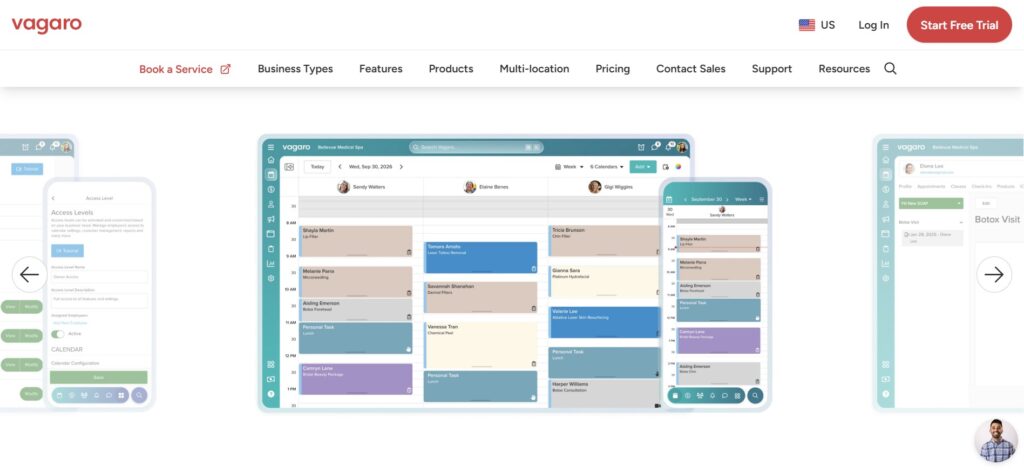
Vagaro is a familiar option for many operators, and its pricing (starting at $23.99/month) is very budget-friendly for smaller teams.
Far and away, one of its best features is resource scheduling. You can configure rooms and equipment as separate resources and require both to be available before an appointment can be confirmed, either as a combined room-plus-device entry or as two independent requirements.
The drawback is that assigning services to providers is completely manual. You’ll have to configure each employee individually and assign permitted services by hand, with no automated credential enforcement to catch errors.
That works in a small, stable team, but as your staff turns over or your service menu grows, the maintenance burden and compliance risk both start to become bigger issues. However, as a feature-rich and budget-friendly option, this is not a bad place to start.
2. PatientNow
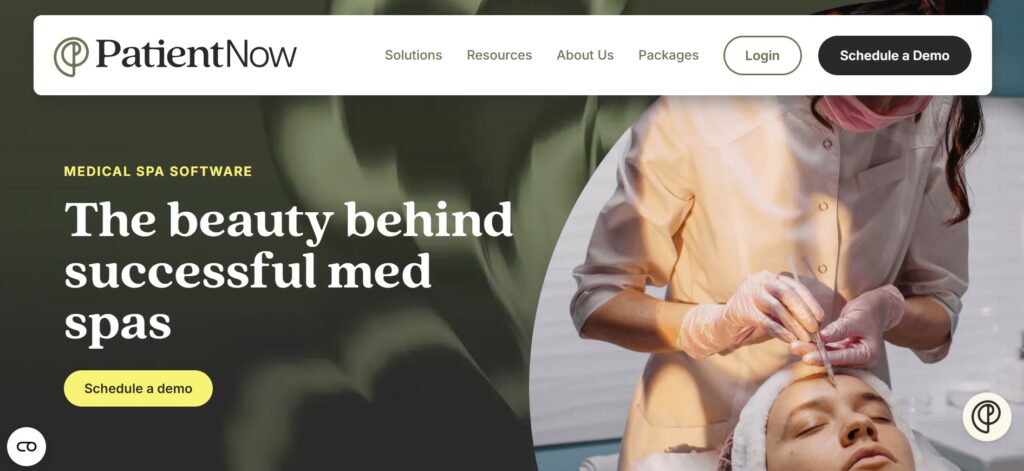
PatientNow focuses heavily on clinical EMR functionality, including robust charting, photo storage and markup tools, e-prescribing, and a built-in marketing suite with AI-driven audience segmentation.
For med spas with a strong clinical orientation — like practices focused on weight loss programs, IV therapy, or dermatology-adjacent services — that focus makes a lot of sense.
But this complexity is also its biggest trade-off. The platform is built around documentation and compliance, with less of a focus on ease-of-use. Med spa owners frequently vent about having to navigate between the patient record and the appointments tab during the booking process, which creates friction at a busy front desk.
There’s also no public pricing, so you have to get in touch with their sales team to get a quote.
Overall, a good pick for the business that knows how to speak its language. But for smaller salons or teams that aren’t tech-fluent, its best features might only get in your way.
3. Zenoti
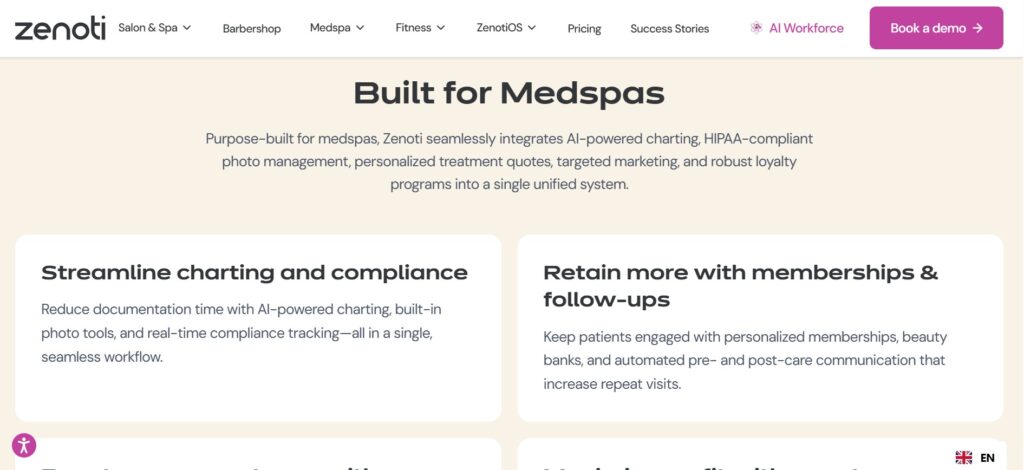
Zenoti operates at the enterprise end of the market, with custom pricing that typically runs several hundred dollars per month.
Its standout scheduling feature automatically identifies your clients’ booking patterns, like which trends in treatment types, which days and time slots are filling fastest, and what services are driving volume. Then, the tool shares those insights in a way that helps you build smarter staff schedules and anticipate demand before it peaks. For example, you might schedule extra staff for a busy day ahead of time, rather than calling around to see who can fill in at the last minute.
However, its deep complexity rivals that of PatientNow’s. The interface is great for tracking compliance and useful data, but it’s not particularly intuitive or easy to learn. For the added benefits of predictive and proactive spa management, it’s definitely worth it — but only if the enterprise price tag makes sense for you.
In the end, it’s best suited for multi-location med spas where compliance and making data-driven decisions are the biggest headaches.
4. Boulevard

Boulevard was built specifically for salons, spas, and med spas, not adapted from a fitness platform or generic healthcare tool.
Its best feature is its precision scheduling, which accounts for your provider availability, room availability, and equipment availability simultaneously. So when a client books multiple services requiring different rooms or devices, the system handles and books those resource transitions automatically.
Service assignment works at the role level and the individual level. For example, you can configure which services are available to RNs vs. NPs vs. estheticians, and then go further by setting a specific provider’s booking block to run longer and bill at a higher rate than the standard role.
And perhaps most importantly for med spa owners, Boulevard also recently launched e-prescribing through a ScriptSure integration, which brings your prescription workflows directly into the same system as scheduling and charting. Scheduling also connects directly to HIPAA-compliant charting, client profiles, payments, and payroll reporting, so revenue attribution happens automatically.
Pricing starts at $369/month for the Essentials plan, and while there isn’t a free trial, you can book a demo with their sales team.
Final Tips on How to Manage Med Spa Staff Scheduling
Effective med spa staff scheduling is less about your providers and more about understanding the natural flow of your business.
So if you’re in the market for scheduling software, look for features such as provider-level service rules that reflect your actual credentialing structure, resource tracking that accounts for rooms and equipment alongside provider time, and service durations that match what treatments truly require. Med spas that get all three right will stop losing so much revenue to double-books, cascade delays, and payroll reconciliation errors.
- Vagaro is a practical starting point for smaller teams that want an accessible price point, with the understanding that more of the compliance maintenance falls on you and your staff, rather than being automatic.
- PatientNow is best suited to clinically oriented practices (weight loss, IV therapy, dermatology-adjacent services) where deep EMR functionality matters most.
- Zenoti is worth serious consideration for growing or multi-location practices where analytics and compliance tracking are the biggest priorities.
- Boulevard is what I’d recommend for aesthetics-focused med spas ready to put a truly complete, all-in-one system in place.
Whichever platform you choose, the most important thing is that it truly empowers you to staff your med spa effectively, rather than making you jump through hoops or find awkward workarounds.

- How to Fill Last-Minute Cancellations at Your Salon - August 3, 2026
- The Best All-in-One Med Spa Software (2026) - May 11, 2026
- How to Manage Med Spa Staff Scheduling - April 29, 2026